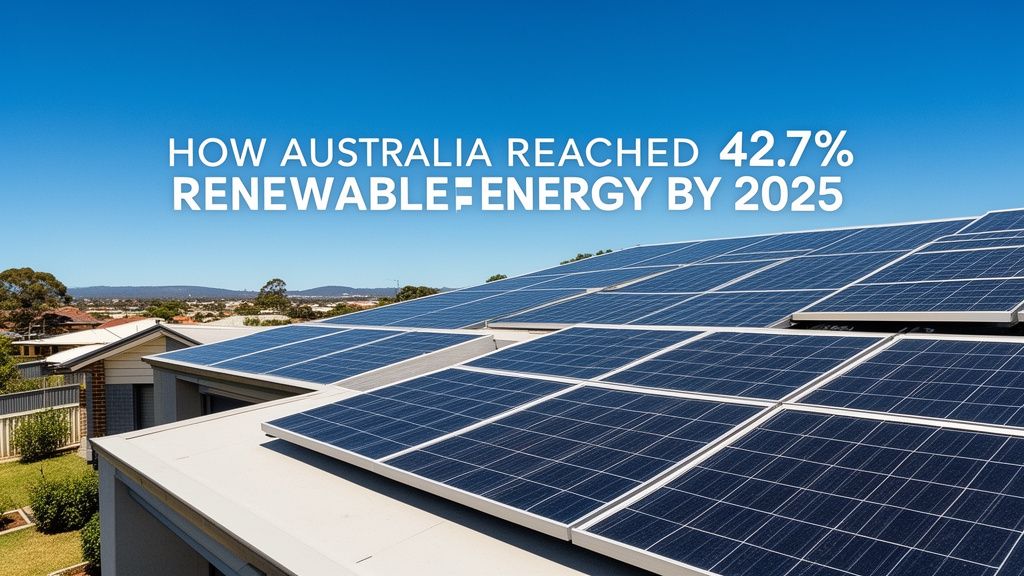
TL;DR: Australia's renewable energy share hit 42.7% in 2025, driven by significant investment in large-scale solar and wind, coupled with crucial grid upgrades. This growth occurred through a mix of diverse technologies like pumped hydro and demand management, reducing the sole reliance on battery storage for grid stability. Government policy and falling project costs made this transition possible.
What major factors drove Australia's renewable energy surge to 42.7% by 2025?
Australia’s climb to 42.7% renewable energy in its national mix by 2025 resulted from a strong push in large-scale solar and wind power generation, supported by a clear policy environment. The Renewable Energy Target (RET) provided a long-term framework, encouraging billions of dollars of investment in new projects across the country. States like Victoria and Queensland set their own ambitious targets, accelerating project development beyond the federal scheme. The sheer amount of available sunshine and wind resources made Australia a prime location for these projects. Industry bodies reported that new large-scale wind and solar farms began connecting at an unprecedented rate from 2022 onwards, adding gigawatts of capacity annually. This surge also included a continued strong uptake of rooftop solar, which contributed significantly to the overall renewable share, reducing household reliance on the grid during peak daylight hours.
How did government policies accelerate renewable generation?
Government policies played a direct hand in rapidly increasing renewable generation. The federal Large-scale Renewable Energy Target (LRET) mandated a certain amount of renewable energy in Australia's electricity supply, providing financial incentives through large-scale generation certificates (LGCs). This scheme lowered the risk for investors and made large projects more attractive. State governments reinforced this with their own targets, such as Queensland’s 50% by 2030 goal, which stimulated the development of Renewable Energy Zones (REZs). These zones strategically co-located generation projects with planned transmission infrastructure, streamlining development and connection. Agencies like the Australian Renewable Energy Agency (ARENA) and the Clean Energy Finance Corporation (CEFC) also provided targeted funding and concessional loans, bridging finance gaps for innovative projects and new technologies.
What was the impact of declining solar and wind project costs?
The economic viability of renewable projects dramatically improved as the cost of generating electricity from solar and wind plummeted. The levelised cost of energy (LCOE) for new utility-scale solar and wind projects became competitive with, and often cheaper than, new fossil fuel generation. This meant developers could build projects without needing as much subsidy, attracting private capital. For instance, the cost of installing large-scale solar PV arrays fell by over 80% in the decade leading up to 2025, according to analysis by the CSIRO. Wind turbine technology also advanced, leading to more efficient and powerful turbines with lower maintenance costs. These cost reductions were a major commercial driver, making renewables the default choice for new power generation capacity.
How did grid infrastructure adapt to integrate higher renewable penetration?
Integrating a 42.7% renewable energy share required substantial upgrades to Australia's grid infrastructure beyond simply adding new generators. The existing transmission network, largely designed for a centralised, one-way flow of power from coal-fired power stations, needed fundamental restructuring. The Australian Energy Market Operator (AEMO) identified key new transmission links vital for connecting the Renewable Energy Zones (REZs) to major load centres. Projects like HumeLink in NSW and VNI West, connecting Victoria and NSW, were either under construction or significantly progressed by 2025. These projects allowed power generated in remote, resource-rich areas to flow efficiently to cities. Smart grid technologies also became more prevalent, enabling better monitoring and control of electricity flows, improving grid resilience and managing intermittency.
What role did new transmission lines play in grid stability?
New transmission lines were essential for maintaining grid stability with high levels of intermittent renewable energy. They acted as superhighways, moving large volumes of power from widely dispersed wind and solar farms to where it was needed. By connecting multiple REZs, these lines reduced the risk of localised power shortages when wind dropped in one area or clouds covered a solar farm. For example, the Queensland SuperGrid plan outlined new high-voltage links designed to move power from northern wind and solar projects down to Brisbane and other population centres. Without this strengthened network, the grid would struggle to handle the variability of renewables, leading to potential congestion or curtailment of renewable generation, which wastes clean energy.
How does demand management contribute to balancing the grid?
Demand management became a critical tool for balancing the grid, particularly as instantaneous renewable penetration grew. Instead of relying solely on supply-side solutions, networks began to actively manage electricity demand. Programs like Virtual Power Plants (VPPs) aggregated rooftop solar and household batteries, allowing them to discharge stored power or reduce consumption during peak demand periods. Smart appliances, like air conditioners and hot water systems, could be remotely controlled by network operators (with customer consent) to shift their energy use to times when renewable energy was abundant and cheap. These flexible demand initiatives helped to smooth out peaks and troughs, reducing the need for traditional peaking power plants and making the grid more responsive to renewable energy fluctuations.


What emerging technologies support grid stability without large-scale battery reliance?
While batteries played a role, a suite of other emerging technologies significantly supported grid stability without the sole reliance on large-scale battery storage. Pumped hydro energy storage (PHES) projects, notably Snowy 2.0, provided long-duration storage and crucial grid services. Synchronous condensers, large rotating machines, were installed at various points in the grid to provide inertia and frequency control, traditionally offered by thermal generators. These non-battery solutions offered different characteristics suited to the Australian grid's specific needs, like providing system strength over extended periods. Green hydrogen production also started to offer a new form of demand, able to soak up excess renewable energy when available, and potentially acting as a long-term storage vector for industrial applications.
How do pumped hydro and synchronous condensers stabilise the grid?
Pumped hydro and synchronous condensers offer different but complementary grid stabilisation services. Pumped hydro, such as the massive Snowy 2.0 project, stores energy by pumping water uphill when electricity is cheap and abundant, then releasing it to generate power when demand is high. It provides inertia and can respond very quickly to changes in grid frequency, acting as a "shock absorber" for the system. Synchronous condensers are essentially old generator turbines repurposed to spin without generating electricity. They provide inertia, helping to maintain stable frequency, and contribute to system strength by providing fault current. These functions are vital for a grid with many inverter-based solar and wind generators, which do not inherently provide these stability services.
What is the future role of green hydrogen and other non-battery storage?
Green hydrogen is shaping up as a significant non-battery storage solution, especially for long-duration or seasonal energy storage. Electrolysers can convert excess renewable electricity into hydrogen, which can then be stored in large quantities in underground caverns or tanks. This hydrogen can power industrial processes, fuel transport, or be re-converted to electricity during periods of low renewable output. While large-scale applications were still developing by 2025, pilot projects were demonstrating its potential. Other non-battery technologies include thermal energy storage, where heat generated by excess renewables is stored in materials like molten salt, and even advanced compressed air energy storage (CAES), which uses surplus electricity to compress air into underground caverns. These options offer diverse ways to manage the intermittency of renewables.
Key Takeaways
- Australia achieved 42.7% renewable energy in its mix by 2025 through a combination of large-scale solar and wind projects.
- Government policies, including the Renewable Energy Target and state-based goals, provided essential frameworks for this growth.
- Declining costs for solar and wind generation made these projects highly competitive and attractive for private investment.
- Significant grid infrastructure upgrades, including new transmission lines and smart grid technologies, were crucial for integrating high renewable penetration.
- Beyond batteries, pumped hydro, synchronous condensers, and demand management strategies played vital roles in maintaining grid stability.
Read More
For a comprehensive overview, check out our master guide: Read the Full Guide Here.