TL;DR: Australia's electricity market is shifting due to increased renewable generation and changing wholesale dynamics. This often leads to volatile retail power prices for consumers, influenced by network charges, retailer strategies, and government policy. Understanding these factors helps homeowners make informed decisions about energy usage and solar investment.
What Factors Influence Australian Retail Electricity Prices?
Retail electricity prices in Australia are a complex blend of wholesale energy costs, network charges, environmental schemes, and retailer margins. The wholesale market, primarily the National Electricity Market (NEM) across the eastern and southern states, determines the cost of generating electricity. This market experiences high volatility, with prices fluctuating dramatically based on demand, supply, and generator availability. For instance, in Q3 2022, average NEM wholesale spot prices in Queensland hit $185/MWh, largely due to high coal and gas prices, which directly impacted retail offers months later.
Network charges, covering the cost of poles and wires, comprise the largest part of a household's electricity bill, often accounting for 40-50% of the total. These charges are regulated and vary by state and distribution zone, paying for the maintenance and upgrade of the infrastructure that delivers power to homes. Retailers add their operational costs, marketing, and profit margins, along with state-specific environmental levies and schemes supporting renewable energy or concession customers. As wholesale prices ease or surge, these changes filter down to new retail offers, though usually with a delay as retailers manage their hedging strategies.
How Wholesale Market Volatility Shapes Retail Offers
Wholesale electricity prices swing minute by minute based on the supply-demand balance in the NEM. When demand peaks, especially on hot afternoons, or when a major generator fails, spot prices can spike from $50/MWh to the market cap of $16,600/MWh for short periods. Retailers buy electricity from this volatile market or through longer-term contracts to manage risk. High wholesale prices force retailers to increase their standing offer and even contract prices for new customers or when existing fixed-rate contracts expire. The Australian Energy Regulator (AER) often cites these wholesale cost increases when setting the Default Market Offer (DMO) prices for NSW, SA, and south-east QLD each year, or when Energy Ministers review the Victorian Default Offer (VDO). For example, the AER's DMO for 2023-24 saw increases of 20-25% in some regions, directly reflecting the preceding period's high wholesale costs.
The Impact of Renewable Energy on Pricing
The rising share of renewable energy, particularly solar and wind, changes the wholesale price landscape. During periods of high solar generation, typically mid-day, wholesale prices in the NEM can drop significantly, sometimes to zero or even negative. This "solar duck curve" effect creates cheaper power during peak solar output. However, renewables also introduce new challenges; they require backup generation or storage for periods without sun or wind. This need for dispatchable power, often from gas or batteries, still comes at a cost, influencing prices when renewable output is low. While more renewables can lower average wholesale costs over time, managing their intermittency requires investment in grid upgrades and storage, which also factors into overall electricity costs.
How Rooftop Solar Changes a Household's Energy Costs
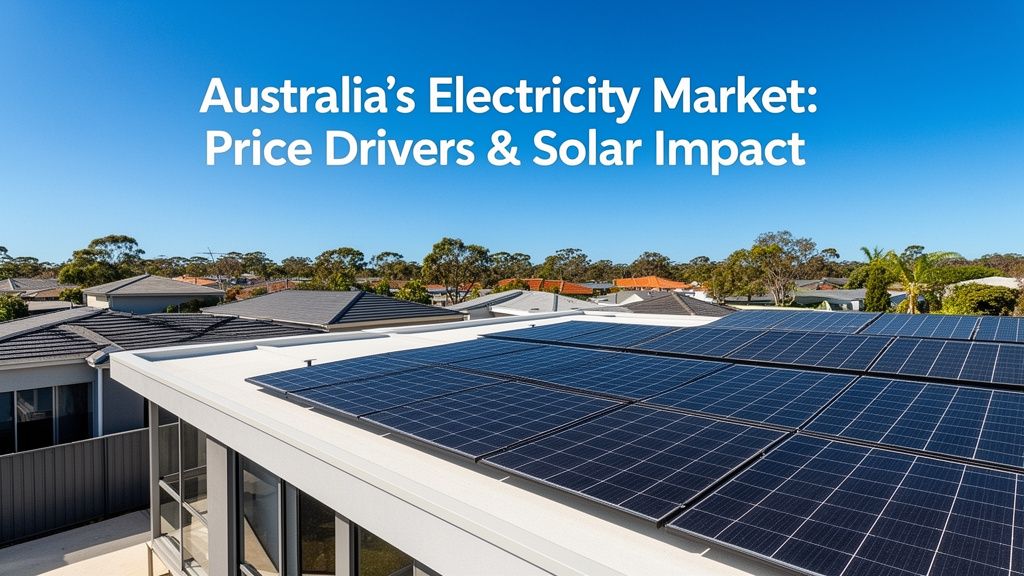
Rooftop solar significantly alters a household's electricity expenditure by generating power locally and reducing reliance on grid electricity. For an average Sydney home with a 6.6kW solar system, they can offset 60-80% of their daytime electricity consumption. This reduces the amount of power purchased from the grid, directly lowering the variable charges on their bill. Excess solar electricity not used by the household then exports to the grid, earning a feed-in tariff (FiT). While FiTs have reduced in recent years, typically ranging from 3-8 cents per kWh in most states, they still provide a credit that further offsets the overall bill.
The direct impact on a household's bottom line depends heavily on their usage patterns and the retailer's tariff structure. Homes that can shift a large portion of their consumption to daytime hours, like running washing machines or dishwashers while the sun is out, maximise their solar self-consumption and achieve the greatest savings. Without solar, these households pay retail rates of 25-40 cents per kWh for all their usage. With solar, they effectively "buy" their own power for free after the system is paid off, making them less susceptible to retail price increases.

Navigating Feed-in Tariffs and Solar Export Credits
Feed-in tariffs are a key component of the solar economic equation for many homes, offering a credit for every kilowatt-hour of surplus electricity sent back to the grid. These tariffs vary widely between retailers and states; for example, in NSW, competitive FiTs might be 5-8 cents/kWh, while in SA they are often lower. Some retailers offer higher FiTs if a customer also buys electricity from them, while others provide a flat rate regardless. It is common for retailers to adjust FiTs, often downwards, in response to high solar penetration on the grid, as the value of exported power during peak solar hours diminishes. Households need to compare not only the retail usage rates but also the FiT when choosing a plan, as a higher FiT can substantially reduce the net cost of grid electricity for those exporting a lot.
The Role of Battery Storage in Maximising Solar Savings
Battery storage addresses the challenge of solar intermittency by storing excess daytime solar generation for use during the evening peak, when electricity prices from the grid are highest. For example, a typical 10kWh home battery can store enough energy from a 6.6kW solar system to power an average home through the evening, reducing or eliminating the need to buy peak-rate electricity. This strategy helps households maximise their self-consumption and further insulate themselves from rising retail prices. While the upfront cost of battery storage remains a significant investment, falling prices and state incentives, like the Victorian Home Battery Rebate of up to $2,950, enhance their economic viability. Pairing solar with a battery provides greater energy independence and financial predictability against volatile retail electricity costs.
What Should Homeowners Look For in an Electricity Retailer?
Homeowners looking to manage their electricity costs effectively need to evaluate retail offers beyond just the headline discount. The most important factors include the actual usage rates (cents/kWh), daily supply charges, and any conditional discounts. Some retailers offer attractive percentage discounts, but these often apply only to the usage component and might come with conditions, such as direct debit or on-time payment. A plan with a lower base rate might be better than one with a high discount on a high base rate. For solar owners, the feed-in tariff is equally important. A low FiT can significantly reduce the overall savings from a solar system, even if the usage rates are competitive.
Understanding your own consumption profile helps choose the right plan. If you use most of your electricity in the evening, a time-of-use (TOU) tariff might offer cheaper off-peak rates but charge more during peak times. If you have solar, you need a plan that balances a good FiT with competitive shoulder and off-peak rates, as you'll likely still draw power from the grid during these times. Regularly comparing offers from different retailers, at least once a year, is an effective way to ensure you are on the most suitable plan for your household's energy needs and solar setup.
Key Takeaways
- Australian retail electricity prices are influenced by wholesale market volatility, network charges, and retailer strategies, often leading to annual price increases.
- Rooftop solar significantly reduces a household's reliance on grid power by offsetting daytime consumption, directly lowering electricity bills.
- Feed-in tariffs provide credits for excess solar power, though their value varies and often reduces as grid solar penetration increases.
- Battery storage maximises solar self-consumption by storing daytime generation for evening use, further reducing grid purchases and peak-rate charges.
- Homeowners should compare total plan costs, including usage rates, daily supply charges, and feed-in tariffs, when choosing an electricity retailer.