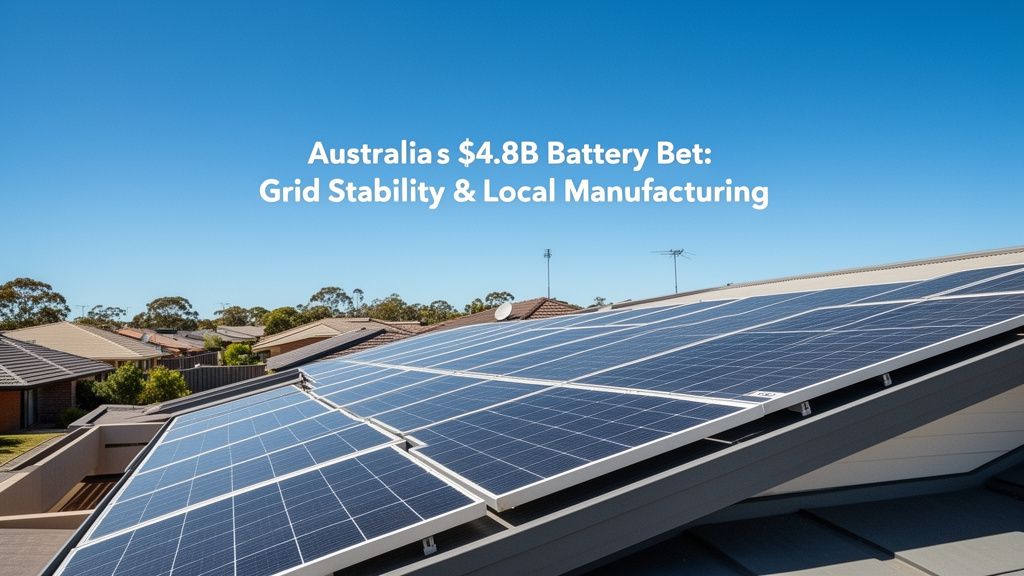
Australia's $4.8 Billion Bet: Financial Commitments for Future Battery Capacity Soar
TL;DR: Australia has committed $4.8 billion to rapidly expand battery storage capacity, aiming to stabilise its electricity grid and support a domestic battery manufacturing industry. This significant investment accelerates the transition to renewable energy, addressing grid reliability issues and offering potential long-term benefits for consumers and businesses through enhanced energy security.
What is Driving Australia's $4.8 Billion Battery Investment?
Australia’s $4.8 billion commitment to battery capacity directly addresses critical challenges within the national energy grid and signals a firm resolve to accelerate the shift away from fossil fuels. As coal-fired power stations retire faster than initially planned, the grid requires massive amounts of reliable, dispatchable power. Batteries provide this stability, soaking up excess renewable energy during sunny or windy periods and releasing it when demand peaks or renewable generation dips. This financial backing underpins the Australian government’s National Battery Strategy, which outlines plans to not only deploy large-scale storage but also to establish a local battery manufacturing supply chain, securing economic benefits and energy independence. The investment reflects a realisation that intermittent renewables, while cost-effective, need significant storage to ensure consistent power supply across a vast continent.
The Grid's Growing Pains and Renewables
The rapid increase in rooftop solar and large-scale wind and solar farms has exposed vulnerabilities in Australia's aging grid infrastructure. Without adequate storage, these renewable sources can sometimes overwhelm the system, leading to curtailment or even instability. For instance, on a particularly sunny spring day in South Australia, solar generation often exceeds demand, but without sufficient storage, some of that clean energy goes unused. The $4.8 billion investment aims to build the necessary capacity to absorb these surpluses, ensuring every electron generated from renewables contributes to the grid. This makes renewables more effective and reduces the need for expensive, quick-start gas power plants, ultimately lowering the overall cost of electricity for consumers. The investment will help smooth out these fluctuations, enabling a more robust and responsive energy system.
Securing a Local Battery Industry
Beyond grid stabilisation, a significant portion of the investment aims to foster a domestic battery industry. Australia holds many of the critical minerals – lithium, nickel, cobalt – essential for modern battery production. Currently, we extract these minerals but export them for processing and manufacturing overseas. The new funding seeks to reverse this trend by offering incentives for local processing and battery cell manufacturing. This strategic move creates jobs, adds value to our natural resources, and strengthens Australia's position in the global clean energy economy. Companies considering setting up shop here now have substantial financial backing and government support, which could see facilities like those planned in Queensland or Western Australia become hubs for battery innovation and production. This local industry development also reduces reliance on international supply chains, which strengthens energy security.
How Will This Investment Translate into Tangible Battery Projects?
This substantial $4.8 billion investment will primarily fund a range of large-scale battery projects and support initiatives aimed at developing Australia's domestic battery manufacturing capabilities. It marks a clear commitment to moving beyond pilot projects to implement significant grid infrastructure upgrades. The funding targets critical gaps in our energy system, allowing the integration of more renewable energy while maintaining system stability. Expect to see new battery energy storage systems (BESS) co-located with existing renewable farms or at strategic points within the transmission network, designed to handle large volumes of power. These projects will scale up from hundreds of megawatts to gigawatt-hours of capacity, providing firming power for millions of Australian homes and businesses.
Grid-Scale Storage Projects Taking Shape
A significant portion of the funds will directly support the construction of "big batteries" across the National Electricity Market (NEM). Projects like the 850MW/1680MWh Waratah Super Battery in NSW, which received significant state and federal backing, exemplify this scale. This battery acts as a "shock absorber" for the grid, allowing more power to flow to Sydney, Newcastle, and Wollongong from new renewable energy zones. Other projects in various stages of development across Queensland, Victoria, and South Australia will also see accelerated progress thanks to this financial boost. For example, Victoria is expanding its grid battery capacity, and South Australia, already a leader in battery deployment, will likely see further enhancements. These batteries offer essential services like frequency regulation and grid stability, crucial for managing a grid with increasing renewable penetration. The investment directly ensures these vital projects proceed swiftly.


Boosting Local Battery Manufacturing
The $4.8 billion also includes allocations for grants, loans, and other incentives designed to attract and establish battery manufacturing facilities on Australian soil. The aim is to move beyond simply exporting raw materials. The government wants to see Australian minerals processed here and converted into battery components, and even complete battery cells. This involves significant upfront capital costs for factories and research and development. The new funding package provides the necessary capital to de-risk these investments for private companies. For example, companies exploring the potential for commercial-scale sodium-ion battery production or even advanced lithium-ion chemistries can now access greater support. This builds sovereign capability and creates new jobs in advanced manufacturing, ensuring Australia captures more value from its mineral wealth instead of exporting the opportunity.
What Does Increased Battery Capacity Mean for Australian Homes and Businesses?
Increased battery capacity across Australia brings substantial benefits for both residential solar owners and commercial energy consumers, extending beyond simply integrating more renewables. The direct impact includes more stable power supply, reduced wholesale electricity prices, and potentially better opportunities to capitalise on rooftop solar investments. When the grid has ample battery storage, it reduces reliance on expensive peak-power generation, which then flows through to lower network charges and wholesale energy costs. For homes and small businesses, this translates to more predictable and potentially lower electricity bills over time. It also means fewer blackouts or brownouts during extreme weather events or unexpected power station outages, as batteries can quickly step in to supply power.
Greater Energy Security and Lower Costs
The expansion of Australia’s battery fleet directly enhances overall energy security. Large-scale batteries provide an immediate backup power source, reducing the risk of widespread outages. When a major transmission line trips or a power plant unexpectedly shuts down, batteries can respond in milliseconds, maintaining grid stability and preventing cascading failures. This improved reliability translates into fewer disruptions for businesses, safeguarding productivity. From a cost perspective, by storing cheap renewable energy and discharging it during high-demand periods, batteries smooth out price volatility in the wholesale electricity market. This reduces the need to fire up expensive gas peaker plants, ultimately lowering the average cost of electricity for all consumers. Over time, these savings filter down to retail tariffs, benefiting every household and business connected to the grid.
Maximising Rooftop Solar Value
For the millions of Australian homes and businesses with rooftop solar, increased grid battery capacity offers a chance to maximise the value of their investment. As more renewable energy enters the grid, feed-in tariffs have steadily declined in many states, sometimes falling below 5c/kWh. Grid-scale batteries can absorb excess solar power during the day when feed-in tariffs are low, then discharge it during evening peaks. This process helps maintain a reasonable market price for exported solar, potentially stabilising or even improving feed-in tariff rates in the long term. More importantly, a stable grid with significant storage means fewer instances of solar curtailment, where energy networks limit how much power rooftop solar can export due to grid constraints. This ensures every kilowatt-hour generated by your solar panels contributes to your savings and the overall energy supply.
Key Takeaways
- The $4.8 billion investment targets grid stability, preventing outages and enabling more renewable energy integration.
- Australia aims to build a local battery manufacturing industry, adding value to its critical mineral resources and creating jobs.
- Large-scale battery projects will reduce wholesale electricity price volatility, potentially leading to lower long-term bills for consumers.
- Increased grid battery capacity will improve energy security and potentially stabilise or improve feed-in tariffs for rooftop solar owners.
- This investment underpins Australia's transition to a renewable energy superpower, supporting a reliable and sustainable electricity supply.
Read More
For a comprehensive overview, check out our master guide: Read the Full Guide Here.