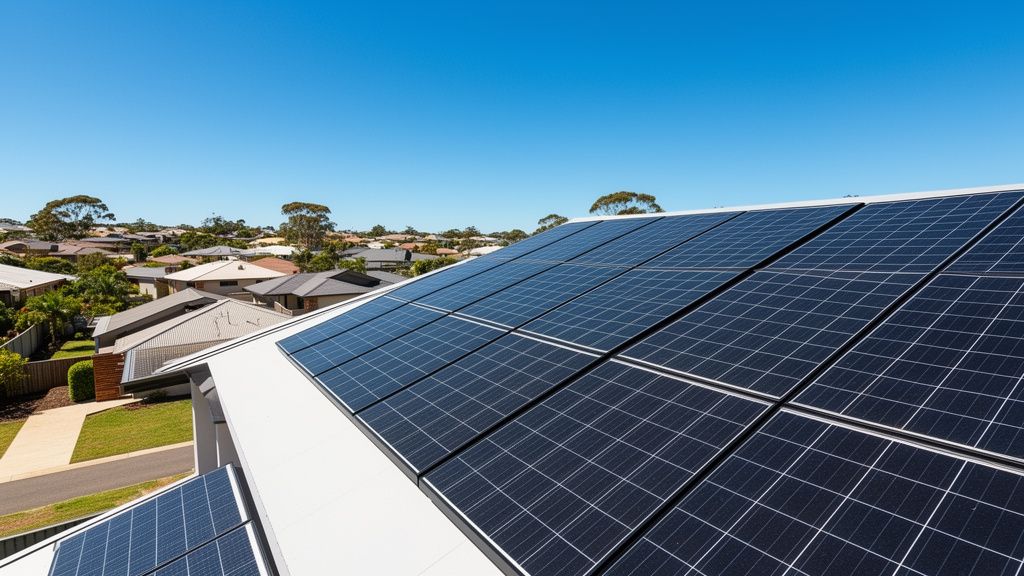
TL;DR: North produces the most kilowatt-hours. East-west produces fewer but more of them land when you are home, which is worth more money now that feed-in tariffs have collapsed. Unless you export a large surplus, east-west often beats north on savings despite generating 15% less.
Why does roof orientation matter so much in Australia?
Because it determines both how much you generate and, more importantly now, when.
In the southern hemisphere the sun tracks across the northern sky. A north-facing array gets the most direct exposure across the day and the year, which is why north has always been the default recommendation.
That recommendation was written when feed-in tariffs were generous and every exported kilowatt-hour was worth close to what you paid for grid power. It is worth revisiting, because it no longer is.
On a typical 6.6kW system costing $5,000 to $10,000 installed, the orientation decision moves your return by more than the panel brand does, and it is fixed once the racking goes on.
What the daily curve looks like
North gives a broad, symmetrical curve peaking around midday. It maximises total annual generation.
East peaks in the morning. West peaks in the afternoon. Each alone produces less than north, and each puts its output at one end of the day.
An east-west split combines both into a flatter, wider curve: generation starts earlier, finishes later, and dips in the middle relative to a north array.
Seasonally, all orientations drop in winter with shorter days and a lower sun angle. Their relative ranking does not change.
Which orientation actually produces the most?
True north, by roughly 20% more annual generation than a comparable east or west array.
Azimuth is measured in degrees clockwise from true north: 0 or 360 is north, 90 east, 180 south, 270 west. Anything between about 330 and 30 degrees is effectively north-facing, losing only a few percent against true north.
That tolerance is wider than people expect, and it means a house that is not aligned to the street grid is usually still fine. Your installer measures this and should tell you the actual azimuth of each roof face rather than describing it as "north-ish".
South-facing is the one to avoid. Solar panels on a south face in Australia produce far less and there is rarely a case for them unless the roof offers nothing else.
Why is east-west often the better financial choice?
Because generation you use is worth several times generation you export.
Feed-in tariffs now sit at 5 to 10 cents per kilowatt-hour in most states. Grid power during the evening peak runs over 30 cents and often past 45. A kilowatt-hour you consume yourself is worth the import rate you avoided; a kilowatt-hour you export is worth the feed-in rate.
A north array peaks at midday, when many households are out. Much of that peak gets exported at the low rate.
An east-west array produces 15% less in total and delivers more of it in the morning and late afternoon, when people are actually home cooking, showering and running appliances. More of it is self-consumed, and self-consumed power is worth four to eight times exported power.
Run the numbers for your own household rather than accepting either answer as a rule.
When north still wins
You export a large surplus anyway. If your consumption is small relative to your array, most generation is exported regardless of orientation, and total kilowatt-hours is what matters. Take north.
You have a battery. A battery decouples generation from consumption entirely. It stores the midday peak and releases it in the evening, which converts north's higher total into usable evening power. With storage, maximise generation.
You have a legacy premium feed-in tariff. If you are still on a scheme paying well above market, exported power is worth close to imported power, and total generation wins again.
Someone is home during the day. Daytime occupancy shifts consumption into the midday window that north serves best.
What else changes performance as much as orientation?
Two things, and shading is the one that ruins systems.
Pitch
For most of Australia, 20 to 30 degrees is the sweet spot for year-round output, putting the panels roughly perpendicular to the sun's average path.
Most Australian tile and tin roofs fall in that range already. Flat roofs need tilt frames, which cost more and take more roof area because rows have to be spaced to avoid shading each other. Steep roofs above about 40 degrees give up a little in summer and gain a little in winter, which is close to a wash annually.
Pitch is a smaller lever than orientation. Do not pay for tilt frames on a pitched roof to chase a few percent.
Shading
Shade is the performance killer, and it is worse than it looks.
On a conventional string system, shading part of one panel can drag down the entire string, sometimes by over 50%. A single chimney, vent pipe, aerial or overhanging branch can therefore cost far more than its physical footprint suggests.
Microinverters and power optimisers let each panel operate independently, which contains the damage to the shaded panel. They cost more and are usually the right call on a shaded roof and unnecessary on a clear one.
Do the survey properly before you commit. Shade moves through the day and through the year, and a roof clear at 10am in December may not be at 3pm in June. A good installer models this rather than eyeballing it, and tree growth over ten years should be part of the assessment.
How should you decide?
Get a Clean Energy Council accredited installer to assess your specific roof: the azimuth of each usable face, the pitch, and a proper shading analysis across the year.
Then ask for two designs: everything on the best north face, and an east-west split. Ask for the estimated annual generation of each and, more importantly, the estimated self-consumption of each against your actual usage pattern.
The second number is the one that decides your bill, and it is the one most quotes leave out.
Key Takeaways
- North produces roughly 20% more annual generation than east or west, and anything between 330 and 30 degrees azimuth is effectively north.
- East-west produces about 15% less in total but delivers more of it when households are home, which is worth more with feed-in tariffs at 5 to 10 cents.
- Choose north if you have a battery, export a large surplus, hold a legacy feed-in tariff, or are home during the day.
- Roof pitch of 20 to 30 degrees suits most of Australia and is a much smaller lever than orientation or shading.
- Shading can cost over 50% of a string's output. Get a proper year-round shading analysis, and consider optimisers only where shade is actually present.