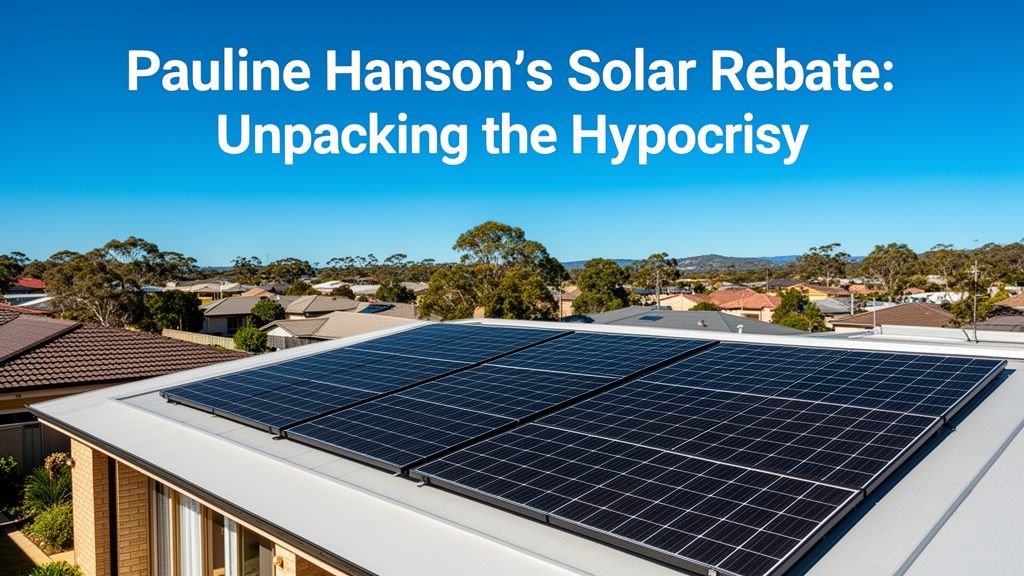
[Pauline Hanson's Solar Rebate: Unpacking the Hypocrisy](/articles/pauline-hanson-s-solar-[rebate)(/categories/rebates/)-unpacking-the-hypocrisy/)
Introduction: A Sunlight Surprise
In the vast, sun-drenched landscape of Australia, where the cost of living continues its relentless climb and energy bills regularly send shivers down the spine, the prospect of government-backed solar rebates is usually met with widespread cheer. After all, Australia has the highest per-capita rooftop solar penetration in the world, reflecting our sunshine and our drive to save a buck. Yet, when the recent proposal for a national solar rebate scheme emanated from Pauline Hanson - a figure historically synonymous with climate scepticism and staunch support for fossil fuels - many felt a significant dose of cognitive dissonance. This policy suggestion represents a political pivot so sharp it warrants a detailed examination of its potential hypocrisy.
Hanson's Proposed Solar Rebate: What's on the Table?
While specifics remain somewhat nebulous, Pauline Hanson's proposed 'Home Solar Rebate' aims to alleviate the burden of soaring electricity costs for average Australian households. The idea, as floated, suggests a rebate program that would significantly reduce the upfront cost of installing solar panels, making renewable energy more accessible to those struggling with their bills - the very "battlers" she often claims to represent. It is pitched as a cost-of-living measure, designed to put money back into people's pockets by helping them reduce their reliance on the grid. On the surface, who could argue with that? Lower power bills mean more disposable income for groceries, petrol, or other essentials.
A Cloudy History: Hanson's Stance on Renewables
To truly unpack the current proposal, we need to take a stroll down memory lane, through the often-blustery corridors of Pauline Hanson's past pronouncements on climate change and renewable energy. For decades, Hanson and her One Nation party have been vocal critics, if not outright dismissers, of climate science. She famously declared that "there is no climate change" and labelled renewable energy as "a joke" and "unreliable".
One Nation's platform has consistently championed coal, advocating for new coal-fired power stations and rejecting policies aimed at transitioning away from fossil fuels. They have decried the cost of renewable energy subsidies, argued against emissions targets, and frequently painted solar and wind as expensive, intermittent, and detrimental to the economy. Phrases like "renewable energy scam" and "destroying our industry" have been common refrains. Her public record has been one of unwavering opposition to the very technologies she now advocates for.
The Glaring Contradiction: From Sceptic to Solar Champion?
Herein lies the rub, the gaping chasm between past rhetoric and present policy suggestion. How can a politician who has spent years railing against climate action, deriding solar and wind power, and advocating for more coal suddenly become a proponent of a national solar rebate? The contradiction is not subtle; it is glaring, like the midday sun over the outback.
For many, this policy shift represents an ideological somersault. It raises serious questions about the sincerity of the proposal. Is this a genuine conversion to the economic and environmental benefits of solar power, or is it a calculated political manoeuvre designed to appeal to a broader, financially squeezed electorate?
Why Now? Political Winds and Pocketbook Pain
The timing of Hanson's solar rebate proposal is significant. Australia is grappling with an undeniable cost-of-living crisis. Inflation is high, interest rates have bitten hard, and energy prices have become a dominant kitchen-table discussion. Households are desperate for relief. Solar power, with its promise of significant long-term savings (a typical 6.6kW system can save a household over $2,000 annually, offsetting an initial outlay of $5,000-$10,000 before rebates), is an attractive proposition.
In this climate, a politician offering a direct financial incentive to reduce a major household expense is likely to gain traction, regardless of their past. It allows Hanson to tap into a widespread pain point and present herself as a pragmatic problem-solver, focused on hip-pocket issues rather than perceived "green" ideologies she has so often scorned. It is a savvy move to pivot from a debate she was losing to one where she can appear to deliver tangible benefits for her constituents.
The Australian Solar Landscape: A Real Need
Regardless of the messenger, the policy itself addresses a genuine need. Australia's climate and ample sunshine make it ideal for solar energy. Millions of homes already have panels, but many more could benefit, particularly those in lower-income brackets or older demographics who might struggle with the upfront investment. Existing state and federal incentives have helped, but a strong, consistent national rebate could accelerate adoption, further reducing demand on the grid and contributing to energy independence.
The irony is that a solar rebate, while anathema to her past stance, is precisely the kind of policy that helps Australians, particularly those in regional areas, gain control over their energy costs. It also inadvertently contributes to Australia's renewable energy transition - a transition she has vociferously opposed.
The Uncomfortable Truth: Can Good Policy Come from Surprising Places?
This situation forces us to confront an uncomfortable truth: sometimes, seemingly good policy ideas can emerge from unexpected, even hypocritical, sources. While Pauline Hanson's history of climate denialism and anti-renewable rhetoric makes her solar rebate proposal deeply paradoxical, the concept of easing the financial burden of solar installation for struggling households is, in itself, a beneficial one.
The challenge for the public and other political parties is to critically assess the policy on its merits, even while acknowledging the glaring inconsistency of its proponent. Is this a genuine shift in perspective, an admission that renewables are indeed part of the solution, or simply a strategic ploy to win votes by latching onto a popular solution to a pressing economic problem?
Conclusion: A Ray of Hope, or Just Political Theatre?
Pauline Hanson's solar rebate proposal is a fascinating, if perplexing, development in Australian politics. It presents a stark contrast to her established political identity and long-held views. While the policy itself could genuinely assist thousands of Australian households grappling with cost-of-living pressures and contribute to our energy security, the obvious hypocrisy inherent in its origin cannot be ignored.
Ultimately, whether this proposal is a cynical act of political opportunism or a belated, pragmatic acknowledgment of solar's undeniable benefits, it forces us to scrutinise not just the policy, but the motivations behind it. For many Australians, a genuine solar rebate would be a welcome relief, but for those who have followed Hanson's career, it is hard to shake the feeling that this particular ray of sunshine comes with a shadowy cloud of contradiction.