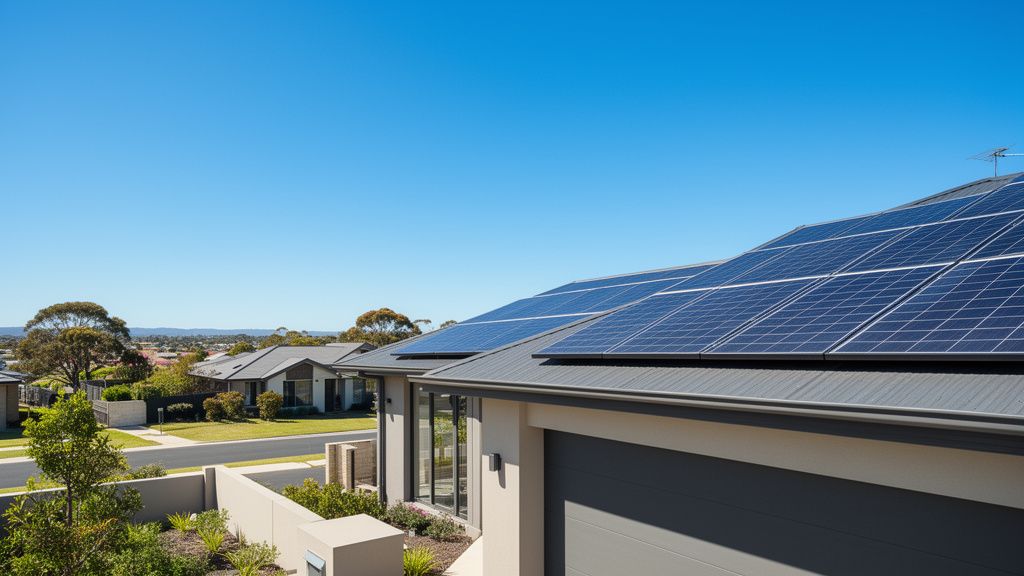
TL;DR: A point-of-sale rebate that comes off the invoice before you pay, not something you claim back later. Your installer applies for it. Eligibility turns on owner-occupier status, a household income threshold, and having at least 5kW of solar.
What is the 2026 Cheaper Home Batteries Discount in Victoria?
A Victorian government rebate that reduces the purchase and installation cost of an approved battery storage system at the point of sale. You pay the discounted price. There is no reimbursement to chase.
That matters for cash flow. A typical 10kWh system runs $10,000 to $18,000 installed, and paying the full amount then waiting months for a refund is a different proposition to paying less on the day.
It is administered by a state entity, in the same way Solar Victoria runs the existing solar and battery rebates.
The wider policy aim is grid stability rather than generosity. Batteries that soak up midday solar and release it in the evening reduce the strain on the network at exactly the hours it is under most pressure, which is why state governments are willing to subsidise them.
Who is Eligible for the Cheaper Home Batteries Discount in Victoria?
Three tests: you own and live in the property, your household income sits under the threshold, and you have or are installing enough solar.
Income and Property Requirements
The combined taxable income of all owners must fall below the threshold for the relevant financial year. Previous Victorian programs have set that around $180,000 per annum, though the 2026 figure is not yet final.
The home must be your primary residence. Holiday homes, businesses and unoccupied new builds are generally excluded.
Ownership structure matters too. Properties held in a trust or a company name have tripped applicants up on previous Victorian schemes, so check yours before you get quotes rather than after.
Existing Solar System Criteria
You need an existing solar array of at least 5kW, or to be installing one at the same time.
The array has to be grid-connected, and the property has to be too. Off-grid properties fall outside these schemes entirely, because the policy goal is easing pressure on the network rather than subsidising storage as such.
The logic is simple: a battery with nothing to fill it is a waste of a subsidy. If your array is smaller than 5kW, bundling a solar upgrade with the battery is usually the path, provided you meet everything else.
Worth checking your actual array size rather than assuming. Systems installed before about 2015 are frequently 3kW or less, and plenty of owners believe they have more than they do.
What is the Application Process to Claim the Discount?
Your installer does it. Your job is to confirm eligibility first and choose an approved one.
Finding an Approved Installer
Only installers on the government's approved list can lodge the rebate. They know which battery models qualify and what the technical requirements are, which matters because a non-qualifying battery means no discount regardless of who fitted it.
Get quotes from several. Approved status sets a floor on quality, not a ceiling on price, and the spread between approved installers on the same system can run into thousands.
Ask each one which battery models they are quoting and confirm those models are on the qualifying list. An installer who cannot answer that immediately has not done this before.
Required Documentation and Key Dates
Proof of identity, evidence of ownership such as a rates notice, and income documentation. Details of your existing solar or your plans for it.
Assemble these before you commit to an installer. A quote that lapses while you chase a rates notice is a common and entirely avoidable delay, and on a capped program a delay can cost you the rebate outright.
Watch the dates. These programs carry funding caps and close when the allocation runs out, sometimes well before the advertised end date. Applying early in a funding round is materially safer than applying late in one.
Previous Victorian solar and battery rebates have exhausted monthly allocations within days of release. If yours works the same way, having your paperwork ready and an installer lined up before the round opens is the difference between getting it and waiting a month.
How Much Can You Save with the 2026 Victorian Battery Discount?
Previous Victorian battery rebates have gone up to $3,500 off the installed price. The 2026 figure will be confirmed closer to launch.
Against a $10,000 to $18,000 system, $3,500 is a 20-35% reduction, which is often what moves a battery from unaffordable to viable.
Check whether it stacks with the federal Cheaper Home Batteries discount, which cuts around 30% through the Small-scale Renewable Energy Scheme. Where two schemes combine, the effective discount is considerably larger than either alone, and installers do not always volunteer that.
The ongoing saving comes from using stored solar in the evening rather than buying grid power at peak rates, which is worth hundreds of dollars a year for a household with real evening consumption.
Some systems can also join a Virtual Power Plant for additional income. Weigh that carefully: VPP participation cycles the battery harder than household use alone, and most battery warranties expire at a stated energy throughput or a cycle count, whichever comes first. Earning VPP credits can bring that expiry forward by years.
Key Takeaways
- The discount comes off your invoice at the point of sale. You do not pay full price and claim back.
- You must be a Victorian owner-occupier in your primary residence, under the income threshold, with at least 5kW of solar.
- Only an approved installer can lodge the application, and only qualifying battery models count.
- Expect up to $3,500, roughly 20-35% off a typical 10kWh system.
- Funding is capped. Apply early in a round rather than late, because programs close when the allocation is exhausted.