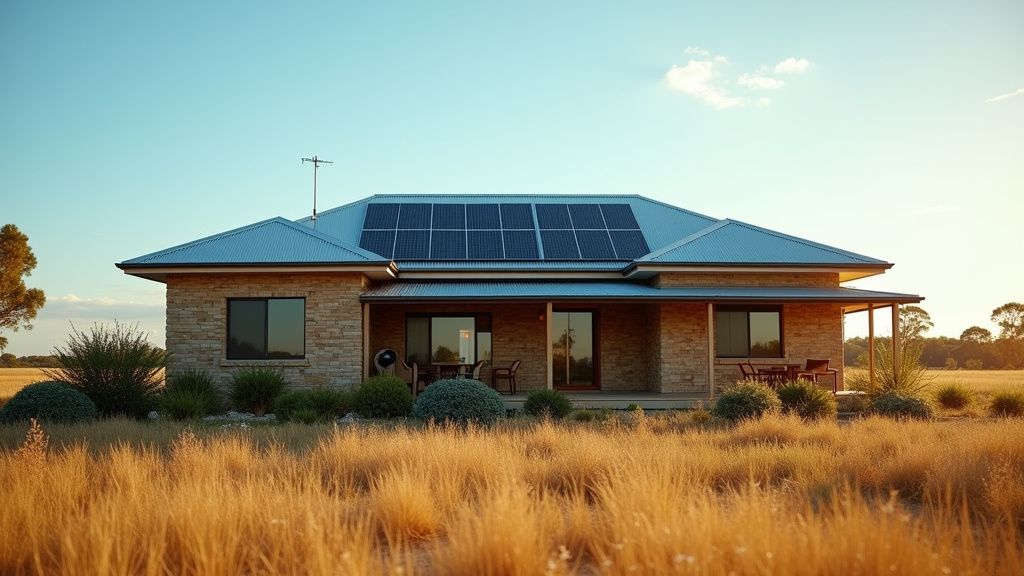
Australia has more sun than almost anywhere, and a lot of properties sitting a long way from the nearest power pole. That combination is why DIY off-grid solar keeps growing here: you generate your own power, store it, and stop paying a retailer for the privilege.
It is a real project, not a weekend job. You need planning, patience and a proper respect for what DC electricity can do to you. But the DC side of an off-grid system is genuinely within reach of a competent hands-on person. Our Complete Guide walks through setting up a hybrid inverter in a shed.
Why Go DIY Off-Grid in Australia?
- Financial Freedom: No quarterly bill, no network charges, no connection fee. The upfront cost is real, but so is never paying a supply charge again.
- Reliability & Resilience: Storms and bushfires take the grid down for days at a time. An off-grid system does not notice.
- Environmental Impact: Your power comes from the roof rather than a coal plant.
- Self-sufficiency: There is real satisfaction in running a house on power you generated, and in regional areas it is often the practical choice rather than the idealistic one.
- Remote Living: If you are far from existing infrastructure, this is usually the cheapest option by a wide margin. Grid connection to a remote block can run into the tens of thousands.
Is DIY Off-Grid for You? Considerations Before You Start
- Your Skill Set: You need a working understanding of electrical principles, enough handyman ability to mount an array properly, and the patience to follow instructions exactly. You do not need to be an electrician. You do need to know where your limits are.
- Time Commitment: Research, sourcing, installation and maintenance all take time, and the maintenance never stops.
- Budget: DIY removes the labour cost, not the component cost. Budget for parts, tools, and a sparky for the stages that need one.
- Safety First: High-voltage DC from solar panels and the stored energy in a battery bank will both kill you. Treat them accordingly.
- Regulations: Off-grid does not mean unregulated. Check with your council about permits for ground-mount structures, and all AC wiring in the house must be done by a licensed electrician.
The Core Components of Your Off-Grid System
- Solar Panels: Your generation. Monocrystalline is the standard choice for efficiency and heat tolerance. Total wattage follows from your consumption and your local sun hours.
- Batteries: Where the power sits until you need it. Lithium Iron Phosphate (LiFePO4) has taken over DIY builds on lifespan, usable depth of discharge and safety compared with lead-acid. Get the sizing right or you will run out at 3 am in July.
- Inverter/Charger: The brain. It converts DC from the panels and batteries into the AC your appliances run on, while the charger manages power flowing into the battery bank. Most modern off-grid units combine both, and a hybrid inverter adds an integrated charge controller.
- Charge Controller (if not integrated): If your inverter has no controller built in, you need a standalone one. It regulates voltage and current from the solar panels into the battery, which is what stops you cooking the bank. Use MPPT, not PWM.
- Mounting System: Rated for Australian wind loads. A cheap frame is how you lose an array.
- Cabling, Fuses, & Safety Switches: UV-resistant DC solar cable, correctly rated breakers and fuses, AC safety switches. None of this is optional.
Your DIY Journey: A Practical Overview
- Assess Your Energy Needs: Every other decision depends on this one. List each appliance, its wattage, and hours of use per day, then total your daily kWh. Be honest, and allow for what you will add later.
- Design & Component Sizing: Size the array and bank against your daily load and your location's average sun hours. Oversize a little for cloudy runs and peak demand.
- Source Your Components: Buy from reputable Australian suppliers. Batteries and inverters are the wrong place to save money.
- System Layout & Wiring Diagrams: Plan where everything physically goes, then draw the DC circuits (solar panels to battery and inverter) and the AC circuits (inverter to distribution board) before you cut a single cable.
- Installation (with professional help for AC):
- Mount Panels: Get the mounting system on and secure first.
- Wire DC Components: Panels to charge controller or inverter, then to the batteries. Check polarity twice and size your cable properly.
- Engage a Licensed Electrician for AC Wiring: Anything touching your switchboard, and the final inverter connection to household circuits, is a licensed electrician's job. They certify compliance with AS/NZS 3000 (Wiring Rules). DIY covers the DC side up to the inverter output.
- Testing & Commissioning: Test everything once it is in and professionally checked. Watch the numbers for the first few weeks.
- Maintenance: Clean the solar panels, watch battery health, and check wiring and connections periodically.
Budgeting for Your Australian DIY Off-Grid System (Estimates)
Prices move, but this is the shape of it in Australian dollars:
- Solar Panels: A 6kW array, around 15-20 panels, runs $2,500 - $5,000.
- Batteries: A LiFePO4 bank of 10-20kWh runs $5,000 - $15,000+. Almost always your biggest line.
- Inverter/Charger: A quality 5-8kW off-grid unit costs $2,000 - $6,000+.
- Mounting System, Cabling, Fuses, Safety Gear: Allow $1,000 - $3,000.
- Professional Electrician (consultation/final AC hookup): Budget $500 - $2,000+.
Total DIY Component Cost: For a family home, expect $10,000 to $30,000+ in components. Fully installed systems commonly run $30,000 to $60,000 or more, and that gap is the entire argument for doing it yourself.
Safety and Regulations: Don't Compromise
Disconnect before you work on anything, use insulated tools, wear the PPE. Read AS/NZS 5033 for photovoltaic arrays and AS/NZS 5139 for battery installations before you start, not after.
Any AC wiring or switchboard connection goes to a licensed electrician. That is the law, and it is also what your insurer will ask about if anything ever goes wrong.
Embrace Your Off-Grid Future
Off-grid is a serious build with a serious payoff. Get the load calculation right, buy decent components, respect the DC side, and hand the AC work to someone licensed. Do that and you end up with a system that runs a house for decades.