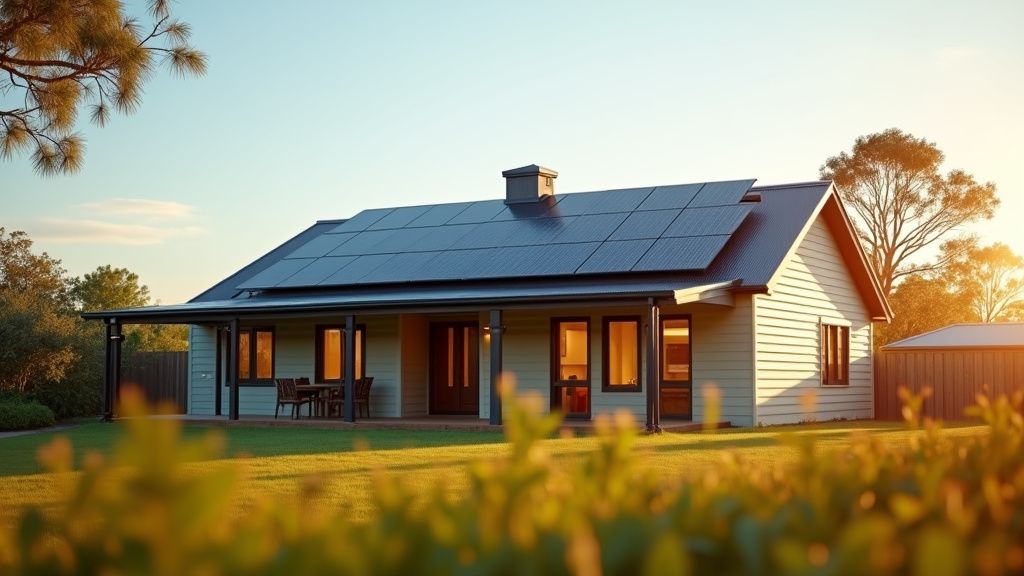
Shade on one panel can drag down an entire string, which is why a single chimney, vent pipe or overhanging branch costs far more output than its physical size suggests.
That problem is solvable, and the solution costs money. Which solution you need depends on how much shade you actually have, so the survey matters more than the hardware. For portable setups in shade, see our Complete Guide.
The Shade Dilemma: Why It's a Big Deal for Your Panels
Your home solar system typically consists of photovoltaic (PV) panels, often grouped into 'strings', and an inverter that converts the panels' DC electricity into usable AC power for your home and the grid. In a conventional setup, these strings are like individual pipelines carrying power. If even a small part of one panel in a string falls into shade - perhaps from a nearby tree, chimney, or even a satellite dish - it can act like a blockage. In older or simpler systems, this single shaded panel could drastically reduce, or even halt, the power output from the entire string. This cascading effect is the primary reason why shade is such a concern.
Thankfully, many modern solar panels come equipped with what are called bypass diodes. These clever components are designed to minimise the impact of partial shading by essentially allowing electricity to flow around the shaded section of a panel, rather than being completely choked off. While they offer a level of mitigation, they don't completely solve the problem of systemic output reduction in heavily shaded conditions.
Proactive Planning: Your First Line of Defence
The most effective way to deal with shade is, of course, to avoid it in the first place. This requires careful foresight and professional assessment:
- Detailed Site Analysis: A reputable solar installer will use sophisticated mapping tools to analyse your roof's sun exposure throughout the day and across all seasons. Sunlight paths change dramatically between summer and winter, so what might be clear in December could be heavily shaded in June.
- Look Ahead for Potential Growth: Solar systems are built to last 25 years or more. Think about those saplings in your neighbour's yard or your own garden. Will they grow tall enough to cast shadows on your panels in a decade or two? Proactive pruning or planting choices can make a huge difference over the lifetime of your system.
- Unavoidable Shade vs. Avoidable Obstacles: While you can plan around trees and structures, you can't control clouds. Passing cloud cover will naturally cause fluctuations in your system's output. These temporary, unpredictable dips are a normal part of solar generation and are distinct from persistent, predictable shade from fixed objects.
Smart Technology for Shady Spots
When avoiding shade isn't entirely possible, technology steps in to help your system maintain its performance.
Maximum Power Point Tracking (MPPT)
Most quality inverters today feature Maximum Power Point Tracking (MPPT). An MPPT controller is essentially the brain of your inverter, constantly optimising the voltage and current from your solar panels to extract the maximum possible power. If a string of panels experiences partial shading or other output discrepancies, the MPPT works to adjust the electrical load to ensure that even the weaker parts of the string contribute as much as they can. Without MPPT, a shaded string might fall below the inverter's operational threshold, leading to a complete loss of its output.
Microinverters and Power Optimisers: The Ultimate Shade Busters
For situations where shade is complex, frequent, or unavoidable, microinverters or power optimisers are often the best solution. These technologies fundamentally change how your solar array operates:
- Microinverters: Instead of one central inverter handling an entire string of panels, a microinverter is installed on each individual solar panel. This means that each panel operates independently. If one panel is shaded, it only affects that panel's output; all other unshaded panels continue to produce power at their maximum potential. This complete isolation dramatically reduces the negative impact of localised shading.
- Power Optimisers: These devices offer a hybrid approach. Like microinverters, power optimisers are installed on each individual panel. However, instead of converting DC to AC at the panel level, they 'optimise' the DC output from each panel, ensuring it's always performing at its peak. This optimised DC power is then sent to a single, central string inverter for conversion to AC. This allows for panel-level optimisation while still benefiting from a single inverter unit.
Both microinverters and power optimisers eliminate the "single point of failure" issue common with traditional string systems, making them incredibly effective for shade-affected installations.
Panel Technology: A Niche Consideration
While most of the focus for shade tolerance is on inverter technology, some panel types do inherently handle shade differently. Amorphous silicon solar cells, for instance, are sometimes cited as being better at dealing with shade than the more common crystalline silicon panels. However, amorphous panels typically have much lower overall efficiency, meaning you'd need significantly more roof space to generate the same amount of power. For most Australian homes, the higher efficiency of crystalline panels still makes them the preferred choice, especially when paired with smart inverter technologies. Emerging "super black" solar cell technologies promise better performance in varied conditions, but these are generally still expensive or not widely available.
Choosing the Right Strategy for Your Aussie Home
Ultimately, the best strategy for building a shade-tolerant solar installation in Australia depends on the specifics of your site:
- Minimal or occasional shade: Good panel placement, panels with bypass diodes, and a string inverter with strong MPPT. Optimisers here are money spent solving a problem you do not have.
- Moderate to complex shade: Microinverters or optimisers. Each panel works independently, so one shaded module stops dragging its neighbours down.
What to Ask For
A year-round shading analysis, not an impression formed on the day of the visit. Any competent installer models the sun path across seasons; shade that is clear at 10am in December can be heavy at 3pm in June.
The estimated annual generation for both designs, string and optimised, so you can see what the extra hardware actually buys. If the difference is a few hundred kilowatt-hours a year, optimisers may not repay their cost.
And an honest answer about the trees. Pruning a branch is cheaper than a panel-level electronics upgrade, and a neighbour's sapling in year three is a different roof in year fifteen.
Shade is a design constraint rather than a disqualification. It changes what you should buy, and it does not change whether solar is worth having.