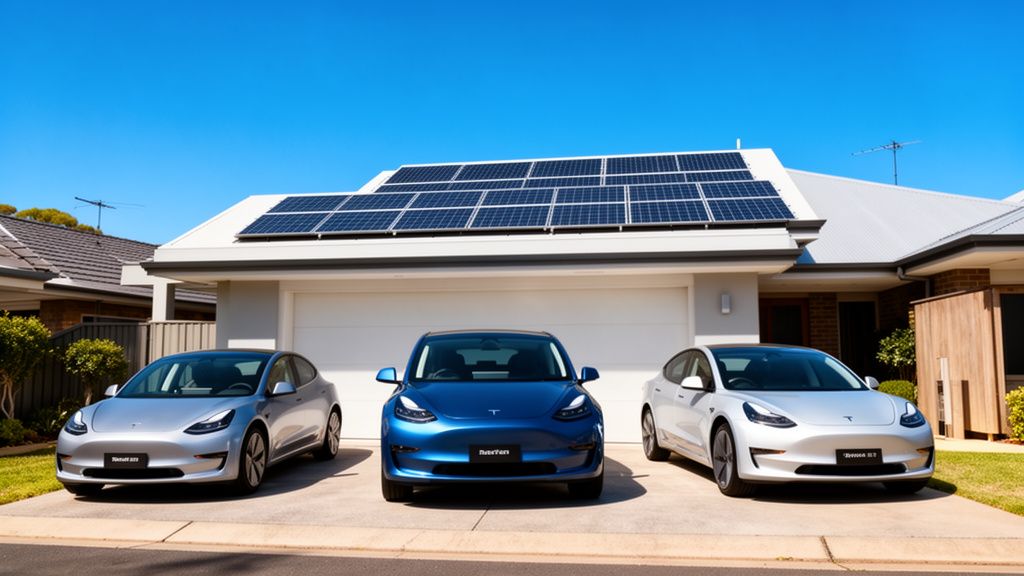
EV pricing in Australia moves faster than any article can track. Treat every figure below as the list price at time of writing and check the current one before you shortlist anything.
What does not move as fast is the decision framework, and for a household with rooftop solar the most important question is not which car. It is whether the car can charge from your surplus.
Work Out What You Actually Need
Range. Australians overestimate this consistently. If your commute is 40km and you charge at home, a 350km car is ample and you will never think about range except on holidays. Long regional driving is where range genuinely matters, and even then charging infrastructure between towns constrains you more than battery capacity does.
Charging at home. This is the one that decides your running cost. With off-street parking and solar panels, you charge on your own generation for close to nothing. Without off-street parking, you rely on public charging and the economics change substantially.
Battery chemistry. LFP tolerates daily charging to 100%, handles heat better, and lasts more cycles. Nickel-based packs offer more range per kilogram and prefer being kept to 80% for daily use, which gives back some of that advantage. For most Australian driving, LFP is the better trade.
Bidirectional capability. Whether the car can power your house or the grid. Still limited by chargers and network rules rather than by cars, and worth checking if it is part of why you are buying.
Sedans and Hatches
Tesla Model 3. From around $61,900 before on-roads, with over 500km WLTP range on the standard model, strong performance and access to the Supercharger network. The interior is minimal to a degree some people dislike and others prefer. Software updates keep adding capability after purchase, which is genuinely unusual.
Hyundai IONIQ 5 and Kia EV6. From roughly $65,000 and $72,500 respectively, sharing the E-GMP platform and its 800V architecture, which supports very fast DC charging where a compatible charger exists. Both offer vehicle-to-load, letting you run appliances directly from the car, which is useful camping and during a blackout. Spacious, and distinctive rather than anonymous.
BYD Atto 3. From about $48,000 before on-roads, with around 345km WLTP range on the Standard Range. LFP chemistry, a well-equipped cabin, and a strong safety suite. The obvious pick for a first EV or a second household car.
SUVs
Tesla Model Y. From around $68,900, Australia's best-selling EV for good reason: Model 3 technology with a usable boot and a higher seating position. If the Model 3 appeals but the practicality does not, this is the answer.
MG ZS EV. From roughly $42,990, among the cheapest electric SUVs available here, with around 320km WLTP range. Not the longest range and comfortably enough for commuting and urban driving. This is what makes EV ownership reachable rather than aspirational.
Hyundai Kona Electric. From about $54,500 for the Standard Range, with the Extended Range reaching 484km WLTP. Compact enough for city driving, proven, and efficient.
Also Worth Watching
Polestar 2, Volvo's XC40 and C40 Recharge, Ford's Mustang Mach-E and Volkswagen's range all expand the field. The more significant movement is at the affordable end, where Chinese manufacturers are competing hard and pulling entry prices down faster than anyone expected.
That competition is why waiting a year sometimes genuinely pays with EVs, in a way it does not with solar.
Charging From Your Own Roof
This is where a solar household gets an advantage that does not appear on any comparison table.
A home wall charger lets you charge overnight on off-peak rates or, better, during the day on your own generation. The difference is stark: exported solar earns 5 to 10 cents a kilowatt-hour, while charging the car with it costs you nothing but the forgone feed-in credit.
An EV doing 15,000km a year uses roughly 2,500kWh. Charged on grid power at 30 cents that is $750 a year. Charged on surplus solar it is closer to $150 in forgone export credits. Against petrol at current prices the gap is larger again.
Two things to get right. Check whether your supply is single or three phase before ordering a charger, because it caps your charging speed regardless of what the charger is rated for. And look for a charger with solar diversion, which ramps charging up and down to match your actual export rather than just running on a timer. Timer-based charging approximates solar charging badly, because generation varies with cloud and household load varies with whatever everyone is doing.
How to Choose
Start with where you park and whether you have solar. That decides your running cost more than the car does.
Then range, honestly assessed against your actual driving rather than your worst imagined trip. Then price, remembering that on-road costs, and in some states stamp duty concessions, move the real figure.
Test drive at least two. EVs differ more from each other in ride, regeneration behaviour and interface than petrol cars do, and those are the things you live with daily.
And check current pricing directly. The figures here were accurate when written and the segment reprices constantly, which is unusual and worth taking advantage of.